Chapter 4: Comparison
🎯 Learning Objectives
By the end of this chapter, you will understand:
- Key differences between Scrum, SAFe, and SysOps frameworks
- Why traditional metrics don’t work for operations teams
- How to communicate framework benefits to stakeholders
- When to use which approach for different types of work
📊 Framework Comparison Overview
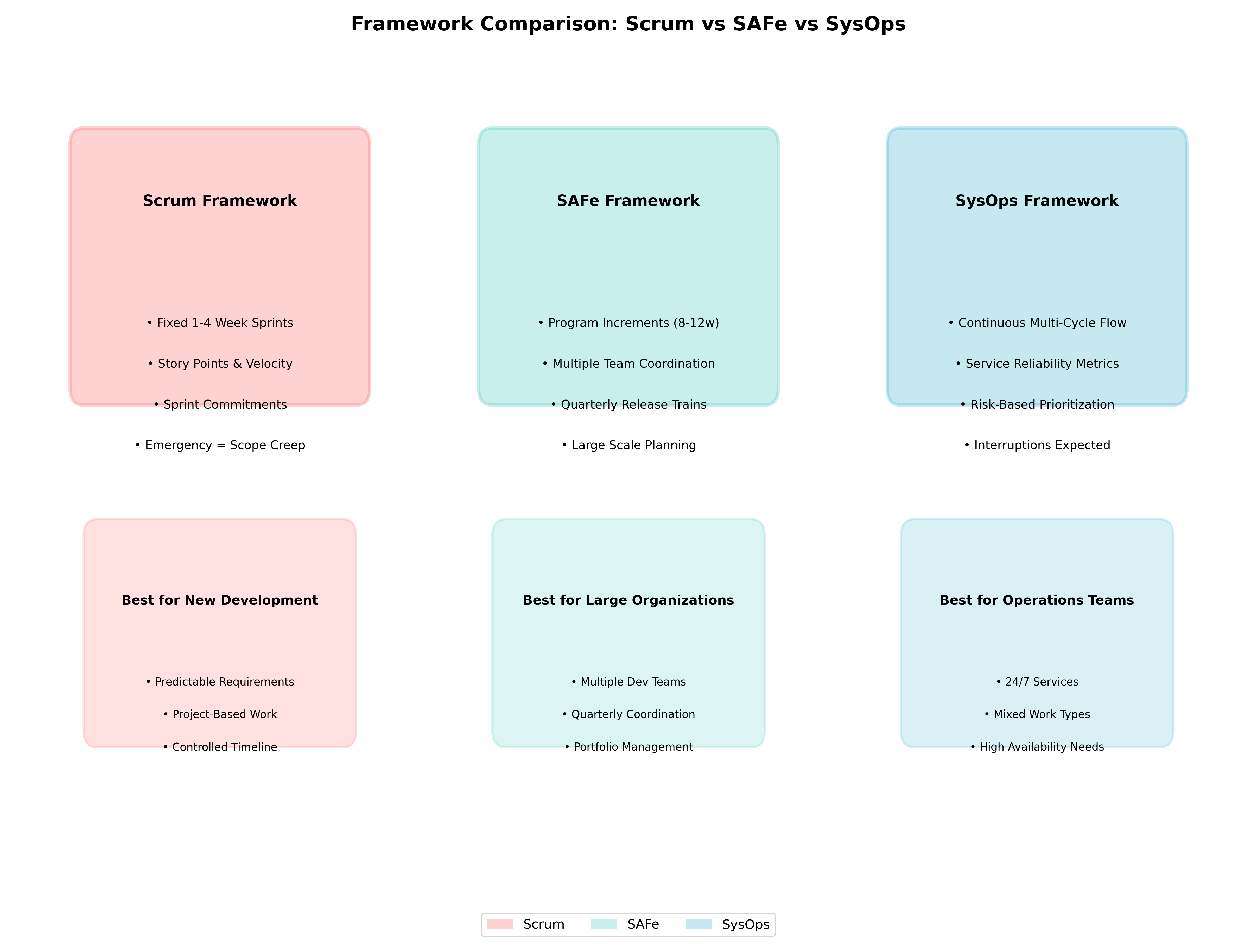
The comparison above illustrates fundamental differences between traditional agile approaches and the SysOps Framework. While each methodology has its place, understanding when and how to apply them is crucial for team success.
🏃♂️ Scrum vs SysOps Framework
Work Structure
Scrum: Fixed sprints (1-4 weeks) with defined start and end points. All work must fit into these containers, regardless of type or urgency.
SysOps: Continuous flow with three overlapping cycles (daily, weekly, monthly). Work flows naturally into the appropriate cycle based on its characteristics.
Why This Matters: Operations work doesn’t respect sprint boundaries. A critical security vulnerability doesn’t wait for sprint planning, and infrastructure migrations can’t be artificially compressed into 2-week sprints.
Planning Approach
Scrum: Sprint planning at the start of each sprint, with commitment to a fixed scope of work.
SysOps: Continuous planning with cycle reviews. Planning happens at multiple time horizons simultaneously.
Real-World Impact: When a major incident occurs mid-sprint, Scrum teams face the choice between abandoning sprint commitments or delaying incident response. SysOps teams handle incidents within their daily cycle while continuing improvement work in the weekly cycle.
Response to Interruptions
Scrum: Interruptions are “scope creep” that threatens sprint success. Emergency protocols exist but are treated as exceptions.
SysOps: Interruptions are expected and planned for. The framework includes built-in protocols for immediate response without disrupting ongoing work.
Example: A database server starts showing signs of failure on Tuesday of a 2-week sprint. In Scrum, this becomes an emergency that “breaks” the sprint. In SysOps, this is handled in the daily operations cycle while weekly improvements and monthly strategic work continue normally.
🏢 SAFe vs SysOps Framework
Scale and Coordination
SAFe: Designed for large-scale development efforts with multiple teams working on related products. Uses Program Increments (8-12 weeks) to coordinate work.
SysOps: Designed for operations teams of any size. Can scale up or down but maintains focus on operational realities rather than development coordination.
Change Management
SAFe: Program-level change management with quarterly planning events. Changes require coordination across multiple teams and stakeholders.
SysOps: Risk-assessed continuous deployment with immediate response capabilities. Changes are evaluated based on operational impact rather than program coordination.
When SAFe Makes Sense for Ops: Large organizations with multiple operations teams supporting related services may benefit from SAFe’s coordination mechanisms, but individual teams should still use SysOps practices for their daily work.
📈 Success Metrics: Why Traditional Metrics Fail Operations Teams
The Velocity Problem
Traditional Metric: Sprint velocity (story points completed per sprint) Why It Fails: Operations work varies wildly in complexity and urgency. A 30-minute password reset and a 30-hour datacenter migration can’t be meaningfully compared using story points.
SysOps Alternative: Service reliability metrics (uptime, MTTR, SLO compliance) combined with operational efficiency measures (automation coverage, toil reduction).
The Commitment Problem
Traditional Metric: Sprint commitment achievement (percentage of committed work completed) Why It Fails: Operations teams can’t commit to work when they don’t control when emergencies occur. Failed commitments due to incidents create artificial failure metrics.
SysOps Alternative: Response effectiveness metrics (incident response time, resolution rate) combined with continuous improvement measures (improvements implemented, process enhancements).
The Burndown Problem
Traditional Metric: Sprint burndown charts showing work remaining over time Why It Fails: Operations work doesn’t “burn down” - it’s continuous. New issues arise constantly, making burndown charts meaningless.
SysOps Alternative: Service health trends (availability over time, performance improvements) combined with capacity utilization metrics.
🎮 Interactive Comparison Exercise
Scenario: Your operations team supports a critical customer service application. This week, you face:
- Planned Work: Migrate database to new hardware (estimated 20 hours)
- Improvement Work: Automate daily backup verification (estimated 8 hours)
- Strategic Work: Evaluate new monitoring platform (estimated 16 hours)
Interruption: Tuesday morning - authentication service fails, affecting 50% of users
How Each Framework Handles This:
Scrum Response:
- Stop current sprint work
- Emergency sprint planning session
- Re-estimate remaining work
- Likely miss sprint commitments
- Retrospective focuses on “what went wrong”
SysOps Response:
- Handle authentication failure in daily operations cycle
- Continue database migration planning in weekly cycle
- Monitoring evaluation continues in monthly cycle
- No “missed commitments” - each cycle handles appropriate work
Exercise Questions:
- Which approach minimizes stress and context switching?
- Which provides better stakeholder communication?
- Which enables faster recovery and learning?
🔄 When to Use Each Approach
Use Traditional Agile When:
- Development-focused work: Building new features or applications
- Predictable scope: Requirements can be defined and estimated accurately
- Controlled timeline: Work can be scheduled at team’s discretion
- Project-based work: Clear beginning, middle, and end
Use SysOps Framework When:
- Operations-focused work: Maintaining, monitoring, and improving existing systems
- Mixed work types: Combination of planned and unplanned work
- Service availability requirements: 24/7 or high-availability expectations
- Interrupt-driven environment: Regular emergencies and urgent requests
Hybrid Approaches
Some teams successfully combine approaches:
- Development projects: Use Scrum for new system development
- Operations work: Use SysOps for ongoing maintenance and support
- Cross-functional teams: Different team members may use different frameworks
📊 Stakeholder Communication Differences
Traditional Agile Stakeholder Updates
- Frequency: End of sprint (every 1-4 weeks)
- Format: Sprint review with demo and burndown charts
- Focus: Features completed and velocity trends
- Challenges: Difficulty explaining operational work that doesn’t produce “demos”
SysOps Stakeholder Updates
- Frequency: Multiple levels (daily status, weekly improvements, monthly strategy)
- Format: Service health reports, improvement summaries, strategic progress
- Focus: Service reliability, operational improvements, strategic initiatives
- Benefits: Better alignment with business continuity and risk management
Sample Stakeholder Communication
Traditional Agile: “We completed 23 story points this sprint, but missed our commitment of 28 points due to production issues.”
SysOps: “We maintained 99.97% uptime this month, implemented automated failover for the payment system, and completed the security framework evaluation ahead of schedule.”
🏆 Success Stories: Framework Transitions
Case Study 1: E-commerce Infrastructure Team
Before (Scrum):
- 40% of sprints “failed” due to production incidents
- Team stress high due to constant sprint disruptions
- Stakeholders frustrated with unpredictable delivery
After (SysOps):
- 99.5% uptime maintained while implementing improvements
- Team satisfaction increased 60%
- Stakeholders gained confidence in operational predictability
Key Change: Stopped treating operational work as “scope creep” and started treating it as the primary job function.
Case Study 2: Financial Services Operations
Before (SAFe):
- Quarterly planning consumed weeks of effort
- Emergency changes required extensive approval processes
- Innovation stalled due to coordination overhead
After (SysOps with SAFe coordination):
- Teams maintained SAFe coordination for strategic initiatives
- Daily operations used SysOps practices for immediate response
- Innovation accelerated through weekly improvement cycles
Key Change: Applied the right framework at the right level - SAFe for strategic coordination, SysOps for operational execution.
⚖️ Framework Selection Criteria
Organizational Factors
- Size: Smaller teams may not need SAFe’s coordination overhead
- Industry: Regulated industries may require different documentation approaches
- Culture: Risk-tolerant vs. risk-averse cultures affect framework choice
- Maturity: Teams new to structured approaches may need simpler frameworks
Technical Factors
- System complexity: More complex systems require more operational focus
- Change frequency: High-change environments need more flexible approaches
- Availability requirements: Higher availability needs favor operations-centric frameworks
- Automation level: More automated environments can handle more ambitious cycles
Work Type Analysis
Create a simple analysis of your team’s work:
| Work Type | Percentage | Predictability | Urgency | Best Framework |
|---|---|---|---|---|
| New development | 20% | High | Low | Scrum |
| Planned maintenance | 30% | Medium | Medium | SysOps Weekly |
| Incident response | 25% | Low | High | SysOps Daily |
| Strategic projects | 25% | Medium | Low | SysOps Monthly |
🚀 Migration Strategies
From Scrum to SysOps
- Start with daily operations cycle - most teams already do this informally
- Add weekly improvement cycle - formalize existing improvement efforts
- Introduce monthly strategy cycle - elevate strategic planning
- Transition metrics gradually - maintain some familiar measures during transition
From Waterfall to SysOps
- Introduce monitoring and feedback loops first
- Implement daily operations cycle for immediate needs
- Add improvement cycles for continuous enhancement
- Scale up strategic cycles as team matures
Hybrid Implementations
- Project teams: Use Scrum for projects, SysOps for operations
- Platform teams: Use SysOps for platform operations, Scrum for platform development
- Cross-functional teams: Different roles use appropriate frameworks
🎯 Chapter Summary
The comparison between traditional agile methodologies and the SysOps Framework highlights fundamental differences in approach, metrics, and stakeholder communication. Understanding these differences helps teams choose the right framework for their work type and organizational context.
The key insight is that there’s no one-size-fits-all solution. The best methodology is the one that matches how the work actually gets done, acknowledges the real constraints and requirements of the team, and provides value to both the team and the organization.
For operations teams, this usually means moving away from development-centric frameworks toward approaches designed specifically for operational realities. However, the transition should be thoughtful and gradual, with clear communication about why the change benefits everyone involved.
🔮 Looking Ahead
In the next chapter, we’ll dive into the practical aspects of implementing the SysOps Framework, including a detailed roadmap, change management strategies, and success metrics for the transition process.
💭 Reflection Questions
- Current State: Which framework most closely matches your team’s current practices?
- Gap Analysis: What are the biggest gaps between your current approach and your ideal methodology?
- Stakeholder Impact: How would changing frameworks affect your relationships with stakeholders and other teams?
🎮 Gamification Element - Chapter 4 Badge Complete the work type analysis for your team and create a framework selection recommendation to earn the “Framework Analyst” badge.
📚 Additional Resources
- Assessment: “Framework Fit Analysis Tool”
- Template: “Stakeholder Communication Comparison”
- Webinar: “Migrating from Agile to Operations-Focused Frameworks”
← Previous: Chapter 3 - Framework Structure | Next: Chapter 5 - Implementation Strategy →
Feedback
Was this page helpful?
Glad to hear it! Please tell us how we can improve.
Sorry to hear that. Please tell us how we can improve.